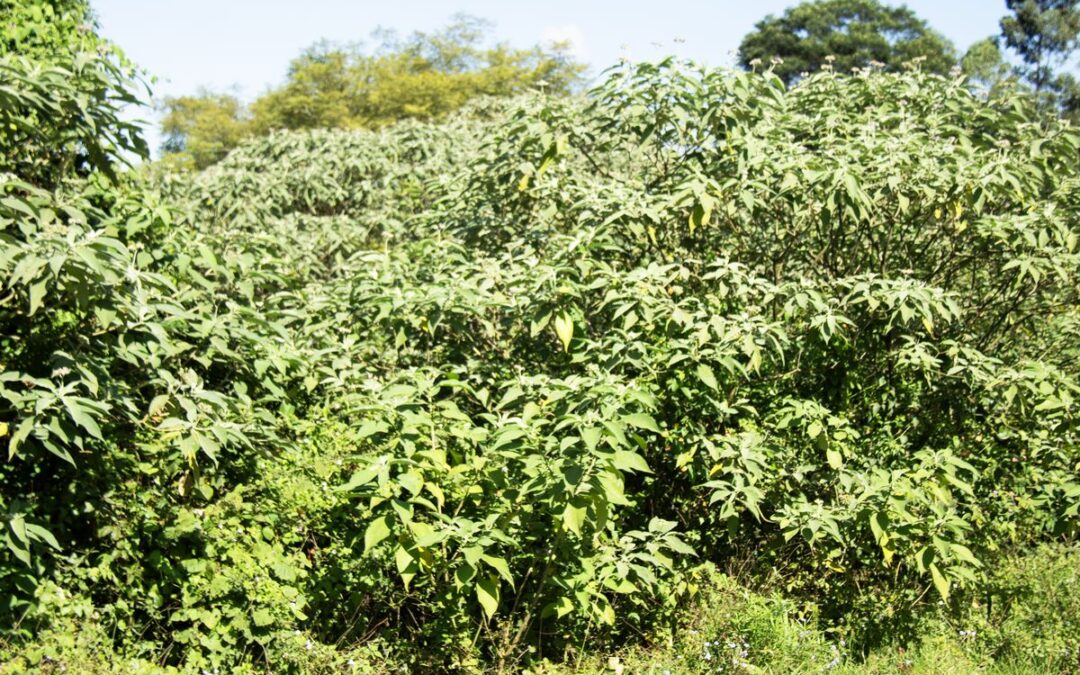
New research out of the University of KwaZulu-Natal suggests that the invasive Bugweed has compounds able to provide sustainable and affordable therapies, which includes treatment for cancer and for use in antibiotics.
By Colleen Dardagan
As most farmers are ardent conservationists, they are well aware of the impact of invasive plant species on the country’s biodiversity, water security and pristine natural habitats.
Species such as Lantana (Lantana camara), Syringa (Melia azedarach) or Tradescantia fluminensis (Wandering Jew) are just some that make up 559 invaders in four categories ranging from category 1a, which are species that must be eradicated and any form of trade or planting is strictly prohibited, to category 3, which are species that may remain in prescribed areas or provinces although any further planting, propagation or trade is prohibited.
Probably the most common of these is (Solanum mauritianum) Bugweed (category 1b).
No one seems to know how this highly invasive plant indigenous to the South Americas found its way to South Africa.
Some suggest it was first introduced to the country 145 years ago, that it was first seen in KwaZulu-Natal in the early 1860s, and that it may have been brought in accidentally as a contaminant in soil by 16th Century Portuguese traders, or perhaps, as a horticultural curiosity.
Urban legend has it that the plant was brought into KwaZulu-Natal in the 1960s as horse feed, but the plant is toxic to most animals and humans, so that seems unlikely.
Highly invasive
However, what we do know is that the plant has become seriously invasive in seven of the country’s nine provinces, particularly in high rainfall areas. With at least 50 seeds in each of its yellow berries produced all year round, it is easily dispersed by the Purple-crested Turaco and the Rameron Pigeon, who eat it mainly in winter when their usual food is scarce. Antelope such as the duiker also feed on the ripe fruit as do monkeys, who then spread the seeds far and wide.
The plant is pollinated by bees, among others, and is also self-pollinating, which means isolated plants can easily reproduce and multiply to form dense populations.
In a 2024 study, Professor Terrence Olckers from the School of Biological and Conservation Sciences at the University of KwaZulu-Natal wrote that the country’s weed legislation lists Bugweed as a “transformer” species, meaning that extensive stands are able to “dominate and replace any canopy or sub-canopy layer of a natural or semi-natural ecosystem, thereby altering its structure, integrity and functioning”.
Olckers describes the success of biological control in combating the spread of the plant as “plagued by slow progress”.
In a 2022 BusinessTech article, Brian van Wilgen from the Centre for Invasion Biology at Stellenbosch University, Andrew Wannenburgh from the Department of Forestry, Fisheries and the Environment, and John Wilson, from the South African National Biodiversity Institute, estimate that South Africa spent R7 billion between 1998 and 2020 “trying to curb the spread of invasive plants”. The researchers say the country needs at least seven times that amount if it is to make noticeable impact on the spread of invasive plants.
Medicinal value
Dr Myuri Parusnath, who recently earned a PhD in Biology from the University of KwaZulu-Natal for research titled Secretory, phytochemical and biological activities of Solanum mauritianum Scop. (Solanaceae), has discovered for the first time that the complex chemical defence systems in the Bugweed have medicinal value.
“I investigated the microscopic structures of the plant, analysed its chemical composition, and evaluated several biological activities, including antioxidant, antibacterial and cytotoxic properties. The main aim was to explore whether the plant could serve as a potential source of natural bioactive compounds,” Parusnath said.
She added that the research was particularly relevant in the context of the growing resistance to antibiotics and a need for alternative healing options. “In many parts of the world, medicinal plants remain an important component of healthcare, and scientific studies such as this help validate and expand our understanding of their potential applications.”
The increasing prevalence of antibiotic resistance among pathogenic microorganisms further underscores the urgent need to identify new therapeutic agents from natural sources with potent antioxidant, cytotoxic and antimicrobial potential, she noted.
Parusnath studied the architecture of the Bugweed’s cells in minute detail using electron microscopy to focus on its chemical elements. What she found supports the ethnomedicinal or traditional and culturally rooted beliefs about the healing properties of the plant by demonstrating antioxidant, cytotoxic and antibacterial activities associated with its phytochemical composition or active plant compounds.
More simply, the invasive weed boasts compounds which could be used to fight cancer, prevent disease and fight the growth of bacteria, or to develop sustainably produced antibiotics, among other therapeutic treatments.
Herbal preparations
The use of medicinal plants on the continent dates back more than 4 000 years and historically served as the primary form of healthcare. Today, an estimated 80% of the African population, including about 27 million South Africans, continue to depend on herbal preparations for their primary health needs, Parusnath said.
Sebua Semenya and Alfred Maroyi from the University of Limpopo show in their 2020 study, titled Medicinal uses of alien plants cultivated and managed in home gardens of Limpopo Province, that Bugweed roots are already used by some traditional healers to treat toothache, gonorrhoea and sexually transmitted infections.
Parusnath provides an extensive list of treatments, which include how the leaf extracts are traditionally administered to treat manioc (cassava) poisoning, while decoctions or boiled extracts are applied externally to relieve haemorrhoids. Seed preparations mixed with coconut oil are used to alleviate rheumatic pain, and both the leaves and fruit are reported to possess analgesic antimicrobial and anti-inflammatory properties.
“In West Africa, it was used in the treatment of yaws, ulcers and infected wounds. In Kenya, there were reports of its use in the traditional management of colorectal cancer and related gastrointestinal conditions, while in South Africa, it is also used to treat diarrhoea, dysentery, infertility and menorrhagia,” she said.
In its natural South American home, Parusnath says, communities eat the plant as a famine food while also using it to treat various ailments.
Solanum as a member of the Solanaceae family is remarkably adaptable, thriving equally in arid deserts and humid rain forests: in fact members of the family occur on all continents except for Antarctica. They grow in forest margins, grasslands, disturbed areas and cultivated lands, reflecting their ecological adaptability and environmental tolerance.
Known as nightshades, some species within the Solanaceae family are valued for their culinary, agriculture, ornamental and medicinal imports – for example, crop species include potatoes, tomatoes and eggplant, while ornamentals include the humble Petunia and Brugmansia.
Unpalatable foliage
The spread of the Bugweed, on the other hand poses “significant ecological and economic challenges”. Its dense canopy suppresses native plants and prevents natural forest regeneration, leading to reduced biodiversity. The unpalatable foliage is reportedly toxic to livestock, while the fine stellate hairs reportedly cause skin and respiratory irritation in people. The fruits act as a host for fruit fly pests such as the Natal fruit fly (Ceratitis rosa,) thereby contributing to the spread of the pest.
But it’s the dense, soft down on the leaves and stems of the plant that are presumed to contribute to the synthesis and secretion of medicinally relevant phytocompounds or natural chemical compounds. Interestingly, plants are believed to produce these compounds to protect themselves from environmental stresses, predation or infection – or, more simply, they are the plant’s immune system.
Parusnath’s research is novel and comprehensively examines the biological activity across the Bugweed’s leaves, stems and fruit. It is the first comprehensive structural, chemical and biological characterisation of the plant, and clarifies its potential applications in pharmacology and nanotechnology-based research. She also suggests that as an invasive species, future research should evaluate the phytochemical yield, chemical consistency and association bioactivity in harvested invasive material to determine whether these populations might provide a reliable biochemical resource.
What the study achieves is to reposition a plant species regarded as an ecological invader to a prospective source of bioactive compounds, suitable for future pharmacological and biotechnological development.