Dr Angelique Kritizinger who is a Senior Lecturer in the Department of Plant and Soil Sciences at the University of Pretoria describes how building a foundation for future artificial pollination success could ultimately lead to improved production where natural pollination is limited.
By Dr Angelique Kritzinger
Successful pollination is the first step towards producing a good macadamia crop.
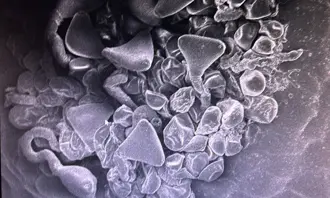
While bees play a vital role in moving pollen between flowers, pollination itself is a much more complex process than simply transferring pollen from one tree to another. For fertilisation to occur, viable pollen must land on a receptive stigma, germinate and grow a pollen tube through the style to reach the ovule. If the pollen is no longer viable or from an incompatible cultivar, fertilisation cannot occur and the flower will eventually be shed. Artificial pollination is a viable option for many crop plants to increase fruit set and quality. However before artificial pollination can be considered questions regarding the pollen and pollination process must be answered. One such question is: can macadamia pollen be collected and stored without losing its ability to fertilise flowers?
Answering this question is becoming increasingly important as interest grows in supplementary and artificial pollination. If pollen can be stored successfully, it could be collected from high-performing polliniser cultivars during flowering and preserved for later use. This would create opportunities for controlled pollination, breeding programmes and, eventually, commercial artificial pollination systems that supplement natural pollination under conditions where fruit set may be limited.
Evaluating pollen storage
To investigate this, pollen was collected from three commercially important South African cultivars: Beaumont, A4 and Nelmak 2. Fresh pollen was first tested to determine its germination potential before being stored under two commonly used storage temperatures, -12 °C and -80 °C. Germination was then evaluated after different storage periods to determine how well the pollen retained its viability over time. Bee-collected pollen from cultivar 816 was also evaluated to determine whether pollen collected using hive-mounted pollen traps could be stored successfully.
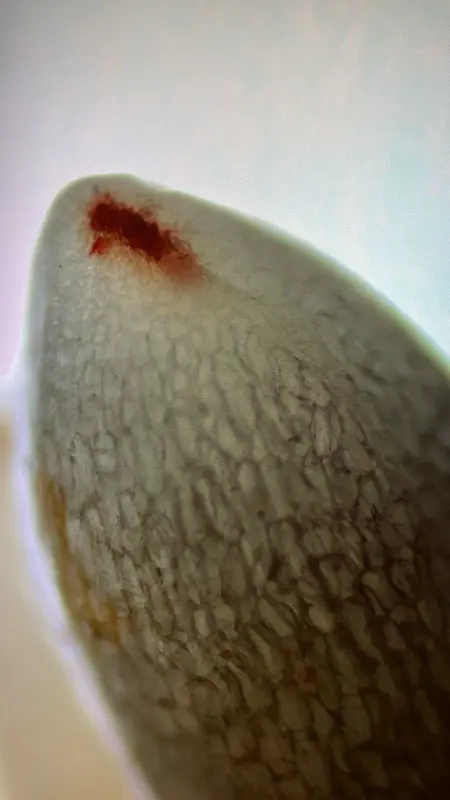
Rather than simply observing whether pollen grains appeared healthy, the study measured their ability to germinate and produce pollen tubes. This is a far more meaningful assessment because only pollen that germinates successfully has the potential to fertilise an ovule.
What did we learn?
The study showed that pollen storage is possible, but that different cultivars respond differently to storage conditions.
Beaumont consistently retained a greater proportion of its germination ability after long-term storage than either A4 or Nelmak 2. Although germination generally declined after extended storage, Beaumont pollen remained comparatively resilient. In contrast, A4 and Nelmak 2 lost much of their germination capacity after one year of storage, regardless of storage temperature, although pollen stored at -80 °C generally performed slightly better than pollen stored at -12 °C. Statistical analyses confirmed that both cultivar and storage treatment significantly influenced pollen germination, demonstrating that storage protocols cannot necessarily be applied equally across all cultivars.
The evaluation of bee-collected pollen also produced encouraging results. Fresh pollen showed the highest germination percentages, but pollen stored at -80 °C consistently maintained higher germination than pollen stored at -12 °C after storage. These findings suggest that pollen collected directly from bee hives may also represent a valuable resource for future pollination applications.
From the laboratory to the orchard: testing stored pollen under field conditions
While laboratory germination tests are essential for determining whether stored pollen remains viable, the ultimate test is whether that pollen can successfully fertilise flowers and produce nuts under orchard conditions. A pollen grain may germinate well in the laboratory, but if it cannot grow through the flower and achieve fertilisation in the field, its practical value is limited.
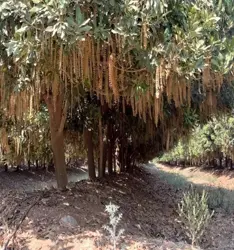
To address this, the research progressed from laboratory experiments to in vivo pollination trials. Controlled hand pollinations were carried out using both fresh and stored pollen to determine whether stored pollen could successfully fertilise macadamia flowers under natural growing conditions. Pollinated racemes were isolated to prevent unwanted pollen contamination, allowing the effects of the applied pollen to be evaluated as accurately as possible.
These field experiments also highlighted some of the practical challenges associated with artificial pollination. Collecting sufficient quantities of pollen, maintaining pollen quality during transport and application, accurately applying pollen to receptive flowers, and protecting pollinated racemes from contamination are all labour-intensive processes. Despite these challenges, the work demonstrated that controlled pollination in commercial orchards is achievable and provides valuable information on how different pollen sources perform under real production conditions.
The in vivo pollination studies form an important bridge between laboratory research and commercial application. They provide confidence that pollen storage research can move beyond germination tests and ultimately be evaluated in terms of fruit set, nut retention and kernel development. This is a critical step towards developing practical artificial pollination systems for the South African macadamia industry.
The research also reinforces the importance of identifying not only how long pollen can be stored, but which cultivars make the best pollen donors. As future studies compare pollen from different cultivars, growers will gain a better understanding of which pollinisers consistently produce successful fertilisation and, potentially, improved nut quality. Combined with ongoing research into pollen tube growth, stigma receptivity and the Effective Pollination Period (EPP), these studies will help develop science-based pollination recommendations tailored to South African orchards.
Why is this important for growers?
Artificial pollination has attracted increasing international interest because it provides a way of increasing the amount of compatible pollen reaching receptive flowers. This could become particularly valuable in orchards where flowering periods of polliniser cultivars do not overlap perfectly, where adverse weather limits bee activity, or where natural pollination is insufficient to maximise fruit set.
However, successful artificial pollination depends on having access to high-quality pollen when it is needed and applying the pollen in the correct, controlled way. Fresh pollen is only available for a relatively short period during flowering, making reliable storage an essential requirement before artificial pollination can become a practical commercial tool.
The current study demonstrates that macadamia pollen can be stored successfully, although cultivar differences need to be considered. These findings provide one of the first building blocks required for developing reliable pollen storage systems and future artificial pollination technologies for the South African macadamia industry.
Artificial pollination – the next step
Pollen storage and reapplication forms only one part of a much larger research programme aimed at improving pollination in macadamia.
Preliminary artificial pollination work has already demonstrated the practical challenges of applying supplementary pollen under orchard conditions, including pollen collection, handling and controlled application to flowering racemes. These studies are helping to refine the methods required for future large-scale artificial pollination.
The next phase of research will build on these findings by determining the Effective Pollination Period (EPP) of important South African cultivars. This work will investigate how long flowers remain receptive, how rapidly pollen tubes grow, how long ovules remain viable, and how these factors interact to determine successful fertilisation. Additional studies will investigate self-incompatibility between cultivars and whether certain pollen parents consistently produce larger or better-quality nuts through xenia. Together, these projects will provide the scientific foundation needed to develop cultivar-specific pollination recommendations and, ultimately, more effective artificial pollination strategies for the macadamia industry.