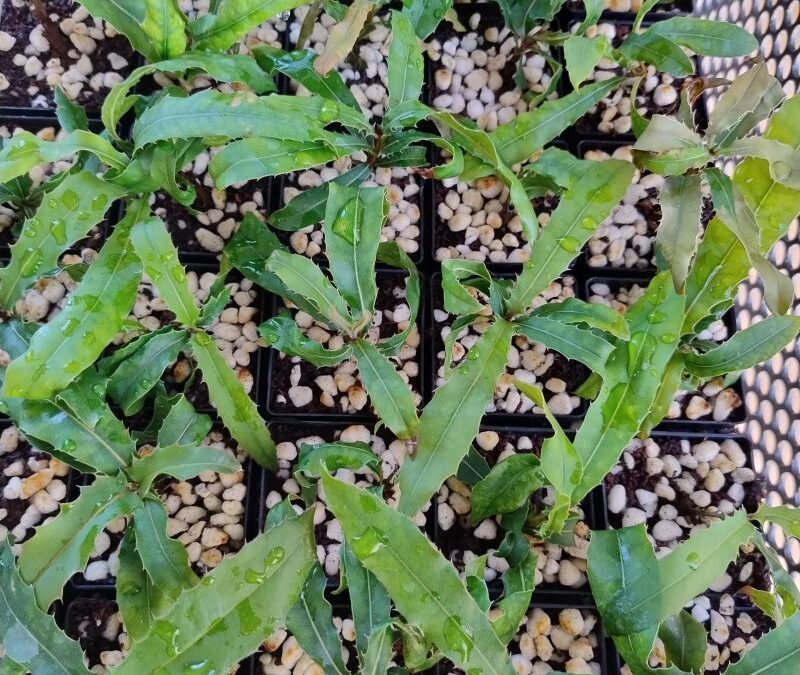
Australian scientists are using green biotechnology to accelerate conservation banking efforts of six of the country’s exceptional priority plants, including the indigenous macadamia, M.jansenii.
By Colleen Dardagan
The project, led by Alice Hayward, a Plant Molecular Physiologist and Senior Research Fellow at The University of Queensland, is funded by the Australian Research Council.
The central aim of the project is to respond to the country’s “urgent biodiversity crisis”, in which many native plants, including the critically endangered Macadamia jansenii, are facing significant threats in the wild.
Hayward says she and her team hope to provide new knowledge into M.jansenii propagation technology and cryopreservation, as well as safeguarding the genetic diversity of this and other species at the Australian PlantBank.
Cryopreservation – according to an online AI enquiry – is the process of cooling and storing biological materials, such as cells, tissues or organs, at temperatures as low as -80°C to 196°C, to stop metabolism and prevent decay, preserving them for future use.
M.jansenii is critically endangered and as a homegrown species on the Australian sub-continent, Haywood says the country has a custodial responsibility to protect the genetic diversity of the species and its eco-systems.
Denise Bond, who heads up the Wild Macadamia Conservation body in the country, said the main threats to the wild macadamia populations were weeds and fire, which threatened the narrow remnants still growing along waterways that provided “critical stepping stones” for cross pollination between the wild trees.
Some of the last remaining remnants of ideal wild macadamia habitats are threatened mainly by invasive vine species like the Cat’s Claw creeper (Dolichandra unguis-cati). In South Africa, the creeper has similarly become a significant invader in cultivated orchards, riparian corridors, natural forest remnants and disturbed areas such as roadsides and urban spaces. The plant was introduced into countries including Australia, New Zealand, India, Mauritius, China, the United States and South Africa, as a garden plant indigenous to South America.
Wild Macadamia Conservation (WMC) authorities in Australia have now set out a specific and targeted strategy to tackle the weed, among a raft of issues in each of the scattered and small remaining areas where the wild macadamia is still holding on.
For example, in Bulburin National Park, north of Brisbane, the WMC is a member of a consortium managing an AUS$500 000 grant from the government to combat the creeping vine and the damage caused by wild pigs.
The indigenous Macadamia tetraphylla has the least amount of protected area remaining and the smallest, least connected remnants, mainly in New South Wales.
Bond said while there are healthy populations listed on their database, they were small, disconnected and threatened by weeds. “We are in the process of development partnerships with First Nations communities to work together to protect the habitat,” she said.
Excerpts in this story were sourced from the regular Wild Macadamia Conservation newsletter.