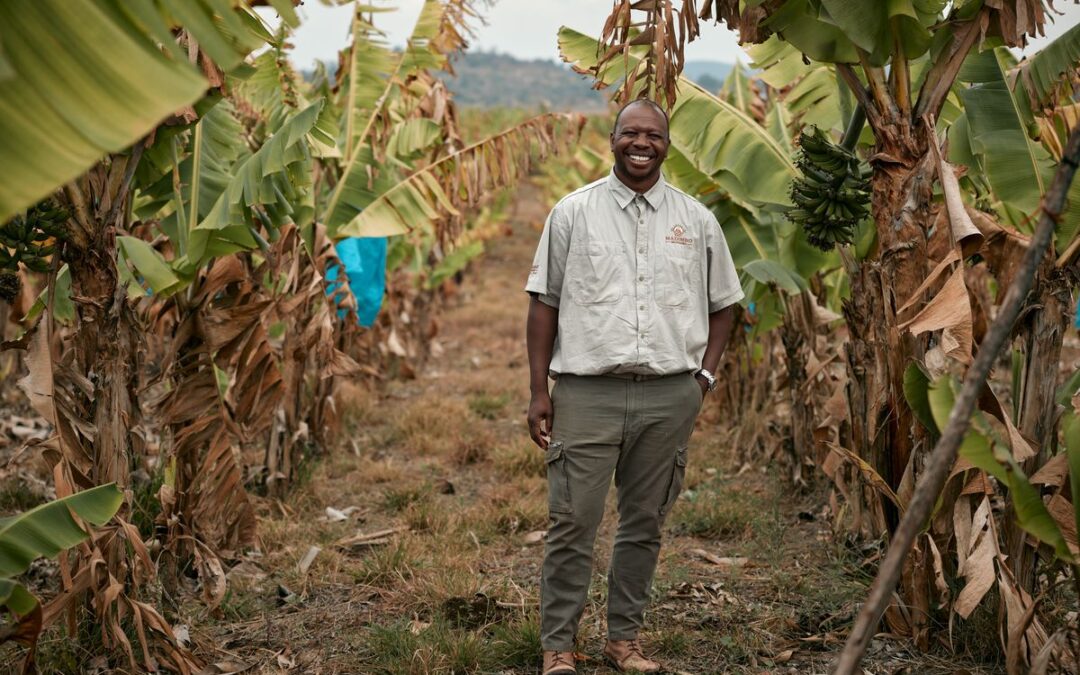
For the first time, more than 150 small-scale macadamia farmers in rural Limpopo will have access to a nut-processing plant, thanks to the vision of local commercial
macadamia and horticultural farmer Gene Likhanya and the SAB Foundation.
By Colleen Dardagan
What started as a conversation between a business consultant and a retired citrus farmer in the early 2000s has grown into a thriving commercial macadamia enterprise focused on small-scale farming growth and development, backed by the SAB Foundation.
The processing business under Gene Likhanya’s Madimbo Macs Processors and a community-based macadamia farming project at Ha-Mashau Village boasts a four-ton-per hour single-lane dehusker and a 40-ton drying capacity, which cost nearly R6 million to build.
Likhanya’s Madview Farm in Ha-Mashau has more than 5 500 macadamia trees, and the community co-operative – called Mac Swarm Group Primary Co-operative – represents 12 small-scale farmers working through a collaborative structure that supports common funding access, shared learning, aligned production goals and co-ordinated development support.
Love of farming
Likhanya, with a self-confessed love for farming, says when he started out in 2003, he knew there were serious barriers to success for small-scale farmers in this country. Small-scale intensive agriculture, particularly when economies of scale and technical know-how are limited, is an uphill journey, with many who are brave enough to try falling by the wayside.
In 2005, he began by planting Beaumonts on 1.5ha of communal land farmed by his family over generations. He planted not knowing how the macadamia nuts were priced nor how they were processed – but he was convinced there was money to be made farming the crop.
The trees were cared for by his mother and brother while Likhanya worked as a business and financial advisor for one of South Africa’s top financial services companies.
However, when Likhanya met his neighbour in the Nelspruit housing complex where he and his family were living, a partnership was formed that would see his vision and dreams come to fruition.
Valuable mentorship
Retired citrus and beef farmer Bruce Andrews said he got to know Likhanya first as a kind and gentlemanly neighbour. “We started chatting and he told me about the macadamia trees he’d planted on his plot in the Madimbo Valley. I had never farmed macadamias but there are many similarities between the successful production of fruit and nut crops. For example, land prep – the most important element of any successful crop farming operation,” Andrews said.
Likhanya said because of Andrews’ valuable mentorship and the SAB Foundation’s backing, he wanted to help others – as he has been helped – by providing technical training, structured support and knowledge based on the lessons he’d learned since planting his first macadamia trees.
“It was intimidating for me to approach Bruce and ask for help. But he answered all my questions and offered invaluable support. The commercial farmers sometimes called me Aluwani (Venda for ‘to grow’ or ‘to prosper’). They would say ‘Aluwani do this’, or ‘don’t do that’, and ‘space the trees like this or like that’. They helped me to avoid the common mistakes,” Likhanya said.
The 41-year-old describes his ancestral land in the Madimbo valley as arable, rich, valuable and God-given, but useless if the community cannot use it to empower their lives. “I know farmers here who have been harvesting macadamia nuts for 15 to 20 years and they still haven’t managed to make much out of it. They would say to me: ‘Something is wrong. The factory won’t accept my macs because of the quality’. They just never understood the value chain and what was acceptable to the market,” he said.
With the help of Andrews and others in the local farming community, Likhanya grew his 1.5ha to 17.5ha over time and diversified his operation to include bananas, avocados, mangoes, livestock and spinach.
“I was self-funded up until 2019 and although the money was running out, I knew there was business to be done in macadamias. But I needed to scale my operation. I knew the higher the production, the cheaper the processing costs, and the more leverage on pricing.”
At this point, he was invited to a farmers’ meeting in Johannesburg. “One of the speakers was from the SAB Foundation. Without a formal introduction I just took a chance and went up to her and introduced myself. I told her who I was and what I did and what I was trying to achieve.”
We could say the rest is history, but what that partnership has since achieved is more than significant.
Today, Likhanya mentors 12 small-scale macadamia farmers in the Madimbo Valley through a co-operative he set up with the help of the foundation.
The foundation has helped them with land preparation, access to water, young trees, and vegetable seedlings to plant between the growing trees. It is also envisioned that each of the farms will eventually extend to a more viable 5ha.
Leading farmer
The foundation has also helped Likhanya expand his Madimbo Agri Group operation by 30ha, which according to the foundation has solidified his standing as a leading farmer in his area. It was on this basis that the 12 small-scale farmers’ consortium was started, aimed at equipping them for sustainable success.
SAB Foundation Head of Programmes Itumeleng Dhlamini said Likhanya was already making an impact in his community via the Mac Swarm Group Primary Co-operative when the team met him in 2019. “It was easy for us to walk this journey with him,” she said.
“What we needed was to make sure he had the right business processes in place to operate as a formal business that could spearhead the group for collective success.”
But in 2021, South Africa’s macadamia industry came to a screeching halt as prices crashed by more than 50% due to a world glut on the back of the Covid-19 pandemic.
The value of a crop described as “white gold” for at least a decade, bringing in massive returns for farmers in this country, was suddenly halved. Growers, who had taken extensive commercial bank loans to develop orchards, were walking a tightrope.
Likhanya pragmatically describes the 2021 crash as “broader adjustment rather than structural decline” and said that the industry is on its way back although, he agreed, farmers were under significant pressure. Increased tariffs into the US and input costs e.g. fuel and fertiliser, have shot up by more than 100% since 2022 when Russia invaded Ukraine.
Further, the unbundling of the state’s power utility, Eskom, has seen above-inflation electricity price increases, adding to financial pressure for farmers, particularly those in the macadamia industry who irrigate.
“The lower price environment is creating real challenges from a capital-raising perspective. Investor sentiment tends to tighten during these cycles, and many funders are understandably more cautious while our sector stabilises,” he said
However, with military training in his background, Likhanya will meet the current obstacles with his customary disciplined attitude. “If you are disciplined you will do what you must do when it must be done – on good days and bad days. The agri-space is tough and there is so much I can’t control, like the weather, input prices, or the price I get for my crop. But quality is quality and if I am committed to producing quality, the rest will look after itself. It’s all well and good to be a passionate farmer, but I like to deliver as a businessman,” he said.