While the macadamia industry has yet to generate enough electricity to go off-grid, agri-processors in the KwaZulu-Natal Midlands are providing a glimpse of what is possible as they move to replace their entire fleet with electric vehicles by 2030.
By Colleen Dardagan
A strategy to cut costs by adopting environmental best practice at one of South Africa’s biggest privately-owned agri-processing plants could provide a blueprint for agricultural transport sectors to follow.
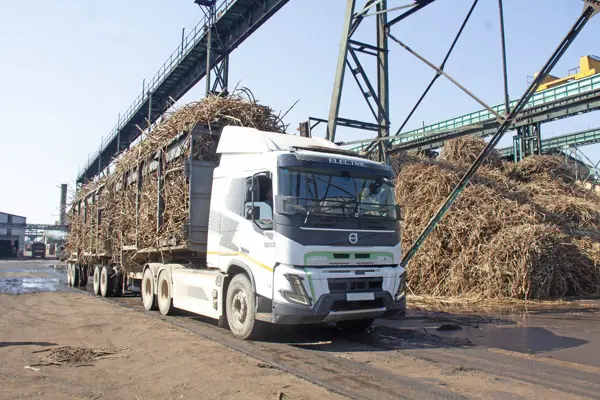
UCL, a sugar milling and wattle bark extract company in the KwaZulu-Natal Midlands, is saving as much as R400 000 a month on diesel costs after introducing two heavy-duty electric truck tractors earlier this year to haul sugarcane.
The savings are expected to increase exponentially as the company replaces most of its 65-vehicle fleet with 35 electric vehicles by the end of 2027.
UCL General Manager Clinton Vermeulen said two Volvo heavy-duty horses introduced earlier this year were already saving R200 000 each per month on diesel costs. “We were looking at ideas on how to best use the additional
3 MW of power our factories generate from excess biomass,” he said. “The electric vehicles are proving to be the most cost effective.”
Ryno Van Zyl, who is UCL’s Factory Manager, said switching to EVs, which was in keeping with the co-operative’s environmental best practice strategy, would not only secure the future sustainability of the company but aligned its operational standards with protocols demanded by export markets like the European Union, China and the United States.
Furthermore, meeting international standards for the company was more critical that ever since the construction and commissioning of its 11 530m2 avocado and kiwi packing house last year. The state-of-the art facility fitted with high-end technology is considered one of the largest in the southern hemisphere, able to process 25 tons of fruit per hour for both domestic and export markets.
With the help of Eric Parry, Senior Manager Sustainable Solutions at Volvo Truck South Africa, sophisticated simulation technology was used to help develop the company’s new sugarcane haulage plan i.e. establishing the most effective use of the excess electricity to drive the most economically and environmentally sustainable transport plan.
While the trucks can cost two to two and a half times more than a diesel equivalent, Parry said the net positives over the vehicle’s lifespan far outweighed the initial outlay. “The batteries have an eight- to ten-year lifespan and can power a 200km-300km round trip,” he added.
Further benefits include a six-year, 720 000km battery warranty on the new generation trucks, so if there’s any fault with the batteries, they are replaced free of charge. Most importantly, the trucks produce zero emissions and need to be serviced only once a year. “In reality the cab and chassis of these trucks are exactly the same as their diesel counterparts: the only difference is they don’t have an internal combustion engine burning diesel fuel,” Parry said.
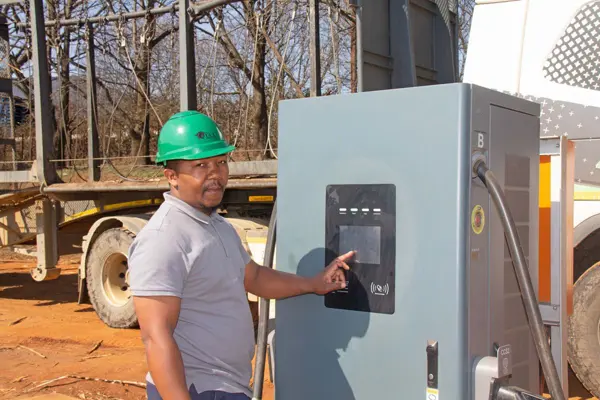
The 240kw charger installed at the Dalton factory has the capacity to charge a fleet of 10 trucks a day, with each battery taking 60 to 90 minutes to charge.
While it is clear the availability of excess biomass in the sugarcane and wattle extracting business is more than what is available in the macadamia industry, both Van Zyl and Parry emphasised that the unique operational requirements of each particular industry could be catered for, as the simulation technology helps to develop a bespoke plan geared for individual operations.
Michka Reynders, Group Operations Manager at Green Farms Nut Company, said the company had replaced the forklifts in its four factories with electric-powered vehicles, however, the introduction of EV inter-links or heavy-duty trucks for transporting the nuts would have to take the shape of a partnership between privately-owned haulage companies.
“Green Farms has a zero-waste policy, so our curing and drying processes are powered by solar power, and we also use grey water. Across our four factories we have about 300 truck movements in a day, but those are privately owned. If we wanted to convert them to EVs we would have to take the lead and start chatting about partnerships,” he said.
While the macadamia shells are also used to generate electricity, Reynders said they were yet to reach a position where there was excess power in the quantity required to power electric vehicles.
“It would require a massive investment, but I do think we have only scratched the surface on what is possible. While transport is not our core business there is potential to build partnerships with third parties, particularly on the introduction of electrically powered heavy-duty vehicles,” he said.
Shaun Worthmann, who owns two companies in KwaZulu-Natal focusing on alternative energy solutions in the agriculture sector – Real Time Energy and Real Time Solar – believes that within 12 months, the macadamia industry could be fully on board with electric-powered vehicles but on-farm, rather than by those transporting the crop for processing.
“The main issue is that the macadamia industry is seasonal. From the perspective of the processors, most of whom generate their own power either from solar or the macadamia shells, they don’t have any excess power during the harvesting period between March and August. They require the same amount of power 24/7 during that period. But then, you have invested in a massive solar system, so we must devise solutions on what to do with the excess solar power generated between September and February. In some instances, we have managed to do a deal with Eskom and they buy the power. But imagine if we were able to sell that power to a transport company to power their vehicles – that is really a creative idea,” he said.
From an individual farmer perspective, Worthmann said, the conversion to EVs was simpler and the cost savings exponential. “If a farmer has installed a solar system to dry his nut crop and there is excess power, he or she can charge a 40kw/hour battery during the day and when the truck or car is parked at night, discharge that power to the car. I’m getting farmers saying, ‘let’s do the bakkie’, because it’s easier right now. When we start talking about the cost of diesel at between R26 or R27 for a litre, that makes absolute sense.”
Having just returned from China where he said every second vehicle – bus or car – was electrically-powered, Worthmann said South Africa’s infrastructure and service support for these vehicles had yet to “mature”.
“When you think the value of a load of macadamia nuts can be pegged at R20 million and the grower isn’t sure whether the electric vehicle has been properly serviced or whether there is adequate charging infrastructure, then you can understand why farmers have lots of questions about those EVs. That’s why we will start to see electric bakkies, forklifts and tractors on farms first before we see the hauliers making the change.”