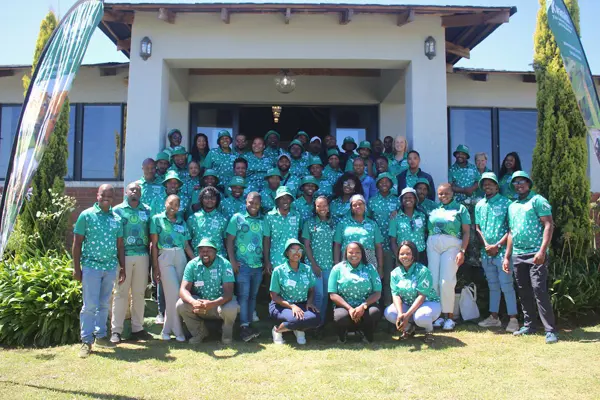
Training success by KwaZulu-Natal’s commercial agriculture union, Kwanalu, has resulted in thousands of young people in the province growing their agri-businesses while creating much-needed employment in their communities.
By Colleen Dardagan
Since KwaZulu-Natal’s commercial agriculture union, Kwanalu, started its rural entrepreneurship programme five years ago, more than 7 600 people have received training, 6 480 have enjoyed agri-businesses support, and more than 20 000 have found work.
Dr Kathy Hurly, who heads up Kwanalu’s Women and Youth Rural Entrepreneurship (WYRE), said that since the programme was introduced in 2021, thousands of women and young people had managed to scale-up their small businesses, bringing change to the livelihoods of almost 200 000 people while adding R200 million to the region’s rural economy.
WYRE is active within a 60km radius of Pietermaritzburg, and anyone with a business in the agriculture value chain is eligible to participate.
“Kwanalu is deeply invested in the rural areas of KZN with a specific focus on agricultural issues, rural development and safety and security. The entrepreneurship programme was launched to boost self-sufficiency and employment through entrepreneurship in the agricultural sector,” Hurly said.
KwaZulu-Natal is home to more than 12 million people, of whom 80%-85% are young and black. Less than half of the population lives in urban areas, mainly in the eThekwini metro – the rest live in rural or non-urban areas. The provincial unemployment rate is pegged at 31.2% while reportedly 45.8% of those between 15 and 34 are locked out of employment because they either lack the skills, knowledge and experience to progress, or have never worked before.
“These statistics about the general standard of living for many people in KwaZulu-Natal matter because the success of the economy, rural development and rural safety and security, depend on an economically active rural population,” Hurly said.
Referring to the political violence that erupted in the province in July 2021, she said the riots were a stark reminder of how thriving rural economies that benefitted as many people as possible were crucial to socio-economic well-being. “It is critical for programmes like WYRE to not only accelerate economic activity so that more employment opportunities are created but to provide options for young people to stay where they are, earn an income from their own businesses, and employ people from their own communities.”
Hurly said research had identified a list of key factors necessary for entrepreneurial success, namely:
- The correct mind-set and energy
- Connections to networks
- Access to land and water and the wherewithal to fully optimise the two
- Technical know-how or access to specialists who are willing and able to share vital knowledge
- Funding and how to use it to best effect
- The availability of mentors, and
- Regular site visits to review their progress
The Kwanalu programme has three fundamental and well-tested activity-based training courses that include Leadership for Life, Enterprise Budgets, and Micro Business Administration.
“Leadership for Life is an international training programme which always has the most impact on the lives and activities of participants. Enterprise Budgets provides a critical tool for funding and farming activities, while the Micro Business Administration course has excellent modules for money management, costing, and pricing,” she said.
During the course, participants were helped to understand the importance of record-keeping, budgeting, marketing and planning their farming operations, and to differentiate between personal and business finances and activities.
Hurly said the regular site visits played an integral role in the success or failure of a project as they provided continued support and advice based on what was observed in the field.
“Participants showed more confidence and professionalism as time went by with this level of mentorship. Early planning and regular monitoring help to identify the challenges before they became major problems, and being hands-on with the participants is essential for the success of their projects.”
Results from the latest group of 50 participants, with 13 startups, 27 small commercial and 10 commercial agri-preneurs all with different enterprises, were mixed. “Employment at the beginning of the project (August 2025) was recorded at 47 jobs. The group added another 47 jobs by the end of July 2026. A total of 94 jobs, a 100% improvement. Interestingly, the startups always outperform the other categories. Three startups pushed their return on investment up by 400% and 500%, while the small commercial group had one star performer and seven above the average, resulting in a return on investment of 350% and an average of just more than 100% for the rest of the group. The commercial participants had three top performers averaging the group out at about 75% to 100%.”
Finding markets
Hurly said the challenge now was to make sure there were markets for the group as their production would ultimately exceed demand. “Participants need to be introduced to retailers, aggregators and metro markets. Another key area is formalising the businesses while making sure they meet all the compliance issues.”
The Kwanalu WYRE programme makes it possible for young people and women living in remote rural areas to get equal access to information and skills development. “I feel very privileged to be part of this programme, as not many people get the chance to make a difference in other people’s lives like I do. Kwanalu makes this possible not only for me but for those who otherwise might not be able to experience such an opportunity. The programme is unique and hugely valuable as it contributes positively to the betterment and prosperity of our rural areas.”.